Featured post

DEMOCRACY, ACCOUNTABILITY, CITIZENSHIP IN MY WORKS 2022-2018

I am studying Tech Governance since 1992 and focusing on artificial intelligence (AI) since 2018. I am heavily  introducing the axis of poli...

Showing posts with label smart cities. Show all posts

Thursday, 16 June 2022

July 2022 Smart Cities Smart Government Research Practice Consortium Workshop

Preparing today on June 16th, for next presentation at the Smart Cities Smart Government Research Practice Consortium Workshop. Discussing about teaching #smartcities: thanks to the institutional umbrella provided by the CGT Albany University. Hosting, Mila Gasco HernandezMeghan Cook


These are great encounters and it is awesome the quality and extent of experts reunited worldwide. This is impressive indeed. Later on, more breakingnews and details on it...

Just some months ago, we published together our first book


Wednesday, 23 February 2022

QUE SON LAS SMART CITIES, UN INFORME SEMINAL DE LA FUNDACION TELEFONICA EN 2011

Un informe de referencia de la Fundación Telefónica, que se publica en 2011, en el que participo como investigadora y que marcará mis investigaciones posteriores en la universidad. Marcará mis investigaciones porque comenzarán a ser colaboraciones con asociaciones y empresas interesadas. Además, servirá para centrar mi trabajo y el de mis equipos en temas relacionados con las ciudades inteligentes, un tema sobre el que sigo dirigiendo tesis doctorales y sobre el que sigo publicando trabajos realizados. 

Smart Cities: un primer paso hacia la Internet de las cosas

Este video nos recuerda esa presentación de Fundación Telefónica "Smart Cities: un primer paso hacia la Internet de las cosas," en la que participan José de la Peña, Salvador Pérez y Pablo Rodríguez. En un diálogo a tres profundizan en lo que significan en 2011 las ciudades inteligentes y qué nos pueden aportar. 


Este video recoge los testimonios de: 

- José de la Peña: Director de Educación y Conocimiento de Fundación Telefónica España en 2011

- Salvador Pérez: Gerente del Observatorio Tecnológico y Responsable de Comunicación de Telefónica I+D en 2011

- Pablo Rodríguez: Director del Centro Telefónica I+D de Barcelona en 2011

Saturday, 19 December 2020

NEW SCIENTIFIC ARTICLE: AN OVERVIEW OF 94 PAPERS REGARDING RECOMMENDER SYSTEMS AND SMART CITIES

Este es el resultado de la primera colaboración entre investigadores de ciencias y humanidades de la Escuela de Informática de la Universidad Autónoma de Madrid, y de la Facultad de Ciencias Políticas y Sociología de la Universidad Complutense. Un ejemplo de trabajo transdisciplinar entre informática de sistemas, liderando la investigación y ciencias políticas, aportando en áreas críticas. 

"Recommender systems for smart cities", available free online 50 days' free access, before June 25, 2020)>>> https://t.co/z70OBvZQRu

Later on available in free repositories such as here in this link

Este trabajo es el primer artículo científico con revisión por pares sobre sistemas de recomendación en ciudades inteligentes. Se trata de una revisión completa de la literatura a la que nos hemos atrevido de la mano de Iván Cantador y de Lara Quijano-Sánchez. A partir de esta revisión de la literatura es posible determinar 1) qué sistemas de recomendción tendrán más impacto de hecho 2) cómo las ideas existentes sobre sistemas de recomendación afectarán a la implementación de soluciones en ciudades.


Los detalles, a continuación 

Survey paper on #recsys for #SmartCities \w Lara Quijano-Sánchez, @icantador, @m_eliciacortes and @olgag at Information Systems journal https://t.co/3MdlbkjLBe 

An overview of 94 literature papers regarding recommender systems and smart cities: 
• Especial focus on approaches that present solutions at a city level.
• #Taxonomy of smart cities dimensions and goals.
• Analysis on trends and promising future research lines.
• Analysis of papers based on context, smart cities and recommender systems’ features.

Thursday, 8 February 2018

A presentation for the global Consortium on Smart Cities at CTG, Albany University

I have volunteered to present myself -applied research and projects- at the quarterly meeting of the Smart Cities and Smart Government Research-Practice Consortium (SCSGRPC), the Center for Technology in Government (University at Albany). This is happening on Thursday, Feb the 8th (at 17h Madrid time)- when 27 members of the consortium have been called upon for the quarterly meeting. We will be working online. 

VIDEO recorded with the first part of my intervention [6 minutes] will be available here soon.

Prof. Olga Gil working at the Office of the Rectors,
IEJRP Lisbon Congress, 2017

Meghan Cook and Theresa Pardo asked me what I have learned from these hectic last six years in my return to Academia, and the two years joining the Consortium. I have learned mainly four things:

First of all, the Consortium gives me a sense of purpose and focus on a long term strategy for my research which is interesting. 

Second of all, I have been proactive contacting members of the Consortium when I need to work collaboratively. 99% of the members I contacted show commitment and help. For instance, I prepared a proposal for EU applied research funding of 10 million euros in 2016-2017.  In drafting this proposal and preparing the international network, members of the consortium where of outmost help and interest. Here I want to thank specially to Gboyega Odjo, who devoted a lot of time to this endaveour, and I feel specially in debt to, and also to Albert Meijer and Manuel Pedro Rodríguez Bolivar. There were more pleople from the consortium joining in the tight last stages, or through members´ recommendation. I want to thank you all of you for your commitment and kind help!!! 

Thirdly, I have learned that for newcomers as prospective leaders, EU projects need coachers with experience as previous leaders. Thus, a professor with this expertise is a rare jewel we should indeed treasure.

And lastly, I have learned that going hand in had with a strong university, as opposed to a weak one do make a difference in terms of credibility when asking for a big part of the pie in funds.

Now, the work I am doing in 2018

I work at Universidad Complutense de Madrid, at the School of Political and Social Sciences. This is public university and a big one, and we have over 4.500 students just in the social and political sciences school alone. The school is particularly strong on administration, theories and  public policy.

I am working on the regulation of data in cities and other levels of government and power, ethics, governance and theoretical implications. I teach on this subject at UCM. Here is the access to the Open Course Ware (in progress).

On research, publishing and advising postgraduate research I will present five highlights: 

  1.  I am publishing on platforms for the agregation of preferences in cities and countries in a comparative perspective. See one example in this PowerPoint:
  2.  I am a member of CITADEL H2020 Empowering Citizens to Transform European PubLic Administrations. H2020 Framework Program (under GA 726755 with 3,6 million euro, running from 1/9/2016 to 1/9/2020) directed by Daniel Diaz-Fuentes, from the University of Cantabria. This is a joint project with the innovation Basque firm Tecnalia as general coordinator. 
  3. I am further working on the analysis of platforms for e-participation together with a team of researchers in the informatics and mathematics school at UAM in Madrid. We focus on the analysis of data on platforms, and the use of recommender systems to make these platforms more useful to users. In particular, I study the governance and power implications of these platforms. These are recent works I am pleased to share with you: on e-governance, and on e-participation [enclosing this link soon].
  4. I am also working with two posdoc and doctoral students, advising on their thesis. We are preparing work to publish on New Chinese Cities, with Zheng Tian-Cheng, and on Participation in Smart Cities, with Elicia Cortés.
  5. From March 2016 to March 2017, I developed a join team to draft a proposal for the European Union H2020 Program. Even though I fail to get the 10 million funding from the Commission, I managed to unite 31 partners, including six cities European and two followers in Latin America (Cali) and China (Shangái). Together with the innovation firm Zabala, we presented a proposal entittled Co-Creating Green Node Networks in Neighborhoods for Urban Inclusion and Social Regeneration (SCC-02-2017). This proposal received a rating of 3.5 out of 5 from the European Commission evaluators. It has not been funded, but I have learned a lot through the process. This short proposal and comments from the EU evaluators are available for members of the consortium here if you are interested:
Previously, I had I published the book that I wrote in English (unpublished in English yet),
"How Cities Are Governed? Smart Cities” [Free downdload: http://tinyurl.com/smartcitiesUCM] The book covers the smart city plans of over eight cities in three different continents: the comparative cases of Shanghai, Iskandar, Cities in Japan, New York, Amsterdam, Malaga, Santander and Tarragona.

This book is based on the theoretical framework advanced by members of the consortium in 2011 to study and analyze smart cities (Chourabi et al, 2011). Chourabi´s work has been widely cited in Spanish afterwards.

A member of my research team, Julio Navío, from UNED University, had an offer to publish it in Spanish at the Mobile World Congress in Barcelona, where he had presented the English version. One of my postgraduate students, Maider Perez de Heredia, translated the English manuscript to Spanish. The work for this research was funded by Colegio Oficial de Ingenieros de Telecomunicación and Accenture.  Part of the funds raised by Prof. Olga Gil for this research went to finance the budgets of the Department of Political Sciences at Universidad Autónoma de Madrid (5%) and to FUAM (20%). Gil was a professor at Universidad Autónoma de Madrid from  2012 to 2015.

These funds from the private sector paid for all the trips and registrations to scientific congresses in the last four years. Olga Gil is very thankful for that!

Wednesday, 24 May 2017

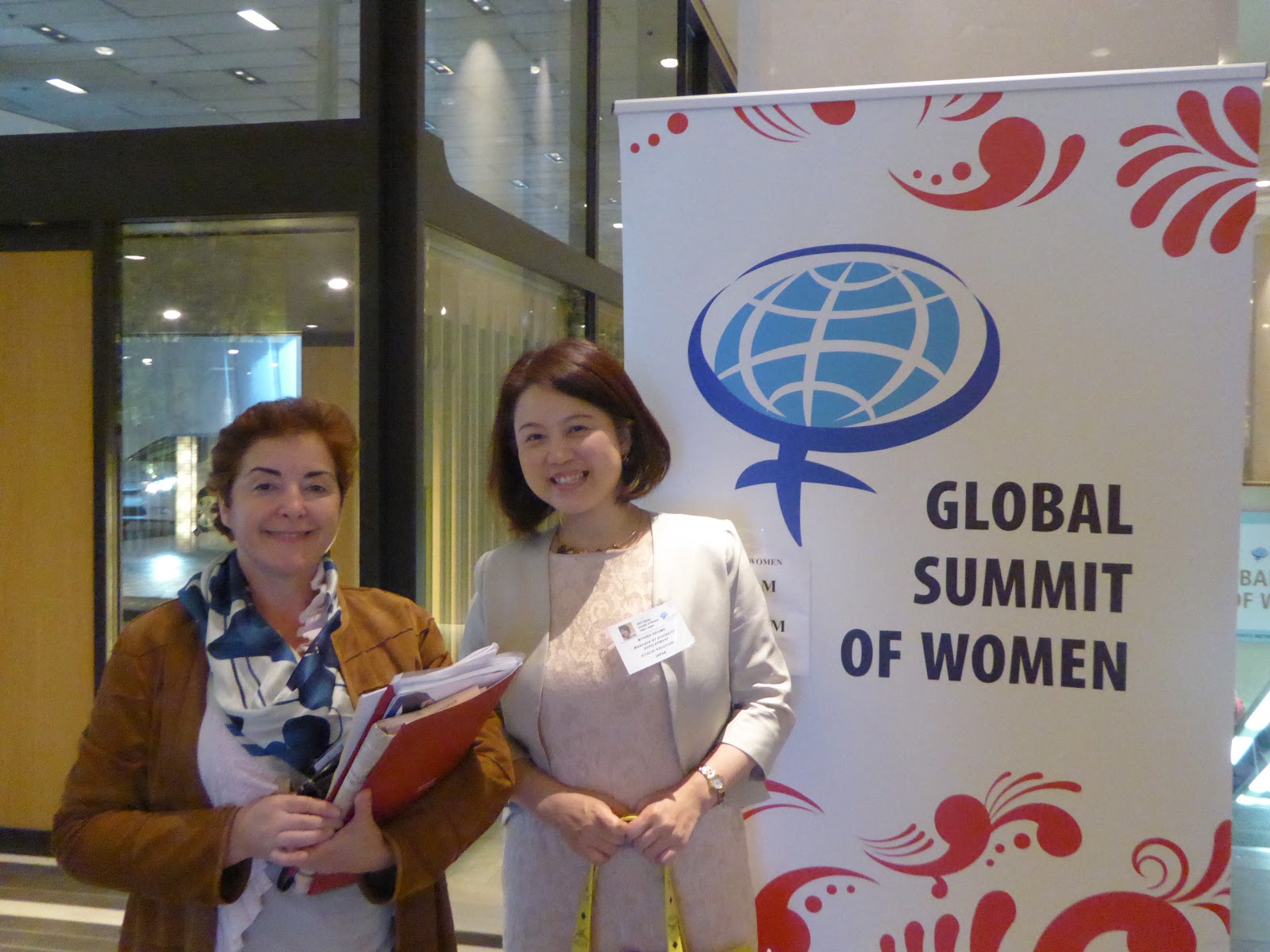
Global Summit of Women 2017, en Tokio, Japón

He participado en la vigésimo cuarta Cumbre Global de Mujeres celebrada en Tokio del 11 al 13 de Mayo, en un viaje de trabajo que se ha extendido del cinco al 14 de mayo. La Cumbre ha permitido trabajar con políticas, directivas de grandes compañías, empresarias y emprendedoras en áreas relacionadas con las ciudades inteligentes. Adicionalmente, se ha analizado y se han tomado medidas para acelerar el acceso al liderazgo político, profesional y empresarial de las mujeres. Y last but not least, la excursión en Japón capitaneada por Margarita de Cos, fuera del programa de la Cumbre, nos deja momentos entrañables y buenos contactos con empresarias españolas interesadas en la innovación y en tejer redes entre universidad, empresa y administración pública.


El Davos de las mujeres
El "Global Summit of Women", es conocido como el "Davos de las mujeres." Fué organizado por primera vez en 1990, y es una cumbre de negocios cuyo foco está en el avance y consolidación del papel de las mujeres en la economía global.

Preparación previa del Global Summit con ayuda del equipo del Embajador de España en Japón

Esta edición de Global Summit of Women es la primera que se celebra en Japón, y gracias a la organización de Margarita de Cos, la delegación española ha tenido ocasión de ser recibida previamente por el equipo de la embajada de España en Japón [@EmbajadaJapon].

El equipo de la Embajada está dirigido por la profesional batuta de Don Gonzalo de Benito Secades. Todo el equipo de la embajada de volcó en la recepción, poniendo mimo y profesionalidad en todos los detalles, compartiendo información que nos ha facilitado en acercamiento a Japón. Tuvimos ocasión de trabajar con todo el equipo de la embajada, entre quienes quiero destacar a Norie Nakao, de la Secretaría del Embajador, y Aurea Iscar, commercial attaché.


Un Global Summit de primer nivel: el primer Ministro Shinzo Abe
 
La edición de Global Summit of Women en Japón ha sido introducida por el Primer Ministro, Shinzo Abe. Su tema ha sido "Más allá del 'Womenomics': acelerando el acceso", y ha contado con la asistencia de unos 1.300 participantes de más de 60 países, y una alta repercusión en medios internacionales, como Finantial Times y nacionales.


La gobernadora de Tokio
 
Entre las participantes se encuentran alcaldesas que gestionan metrópolis, como Yuriko Koike, gobernadora de Tokio. Una metrópolis con un PIB superior al de México. El ejemplo de Yuriko Koike muestra el gran recorrido que puede ejercerse desde el liderazgo en las ciudades en el siglo XXI.

Dos tendencias nuevas con impacto a nivel global
 
La celebración de Global Summit of Women 2017 en Japón refleja dos tendencias nuevas que tienen un punto en común, Asia toma el listón en la carrera de relevos de las relaciones internacionales comerciales
1) Cómo Asia está tomando el listón que ha dejado Trump y se está abriendo al mundo. Más de lo que ya lo veía haciendo. Las asiáticas se han volcado en las reuniones y el networking en este Global Summit, de forma diferencial a como lo venían haciendo en Summits anteriores.

2) El compromiso del primer ministro Shinzo Abe para mejorar el ranking de igualdad entre mujeres y hombres. Los rankings de igualdad entre hombres y mujeres sitúan a Japón en los últimos puestos de la lista. El Índice de Brecha Global de Género del Foro Económico Mundial colocó en 2016 al país asiático en la posición número 111 de un total de 144 países.

Como contrapunto en Asia, Filipinas, donde la vicepresidenta de Filipinas, Leni Robredo, afirmó estár orgullosa de lo que su país ha conseguido en términos de igualdad de género -es el único país asiático incluido entre los diez mejores en el Índice de Brecha Global de Género del Foro Económico Mundial.

La delegación española


Las 47 mujeres de la delegación española destacan por su liderazgo y compromiso en favor de la mejora económica de la situación de la mujer. El dossier de la Delegación completa está disponible pulsando este enlace: Tokyo 2017 Spanish Delegation... y sorprende por el nivel y el talento que agrupa.  Mencionemos a algunas, pendientes de un nuevo post en el que se trate en detalle a la delegación española: Margarita de Cos, directora de WWF España e integrante del comité internacional de planificación de la Cumbre Global, junto con Gloria Lorenzo, directiva de Oracle y vicepresidenta de la delegación española. También The Darwinians, cuya agencia de comunicación ha hecho un trabajo exquisito, comenzando por el libro de la delegación española en la Cumbre que está disponible en gsw-spain.org.  El equipo de Darwinians ha estado capitaneado por Marta Galvez. Mercedes Wullich, que desde Mujeres y Cia se ha ocupado de amplificar para España y Latinoamérica el eco de este viaje de emprendedoras.


También destacan en la delegación española mujeres que trabajan en algún aspecto relacionado con las ciudades inteligentes, como la siguiente lista - que aun no es exhaustiva: Rocío Hortigüela, CEO de Entiba (The Rural Alliance for Electrification), Rita Gasalla, Regina Llopis, presidenta del Grupo AIA summiteras de años anteriores, como Lola Elejalde, de Prospectiva en Innobasque, Erika Vallespín, Marketing Director en ATKearney. A este grupo se suman Pascale Bang-Rouhet, empresaria y CEO de Expresarte, Ana Durán, directiva de Parmalat; Carlota Lorenzana, empresaria, CEO de Aparto Suites Muralto --el lugar donde me alojo en Madrid capital, en calle Princesa y cerca del Parque del Oeste -los mejores atardeceres de la ciudad; Mercè Ribera, CEO de Atrevia, consultora global de comunicación.

El trabajo en Japón con especialistas y asesoras de gobiernos locales en planes de ciudades inteligentes
Volviendo a Tokio, en Global Summit han destacado también los contactos e intercambio con especialistas japonesas asesoras de ciudades japonesas en planes de smart cities, como Miyuki Matsuda, Executive Advisor to the President, de Fukoaka Women´s University y equipos de gobierno local.


Los contactos e intercambio con empresas japonesas trabajando en aspectos de ciudades inteligentes, como ReadyFor, la mayor plataforma de Japón -similar a Facebook- dirigida por Haruka Mera; con ONGs, como Women Help Women, dirigida por Sachiko Fujii
+


Así como empresas con sedes en España, como Denise Evans, de IBM USA, Miyoko Kojima, Rico Amari y Satoko Tsukiori, de Hitachi. Empresas en la vanguardia de la innovación, capitaneadas por mujeres como Masako Oshima, de E-square -que controla una cadena de producción y restuarantes relacionados con productos orgánicos (relacionado con nuestro proyecto nature based solutions for smart cities) y Zhu Zhu, presidente y senior engineer de HY Shanghai Company.


Destacar también los contactos con investigadoras para trabajar en red, como Sachico Kawaji, senior researcher en Toyota R&D Labs; y los contactos con universidades japonesas, muy interesadas en abrirse al mundo y aprender de Europa, entre las que destacan Eiko Yamashita de Kyushu Sanhyo University y Yolanda Alfaro Tsuda, de Kobe College, entre otras.

Y contactos con políticos y cuadros técnicos, mujeres en gabinetes en gobiernos extranjeros, como Túnez o la ex presidente de Zambia, en Africa.


Friday, 28 April 2017

Wrap up meeting after the first stage of the Call Nature Based Solutions for Smart Cities. Sharing Lessons Learned

The meeting, prepared by Olga Gil has summed up on the learning experiences of the H2020 process together with Zabala. It has taken place in Villafranca del Castillo´s UCJC Campus on April the 5th, 2017. We have recorded the session, that will  soon be available for partners that could no attend. Attendants included our consultancy partners: Zabala, as well as our Vicerrector for Innovation and Research, the Director of the School of Arquitectura, the company Dot GIS Corporation, representatives from the School of Architecture and from the School of Communications, Rosa María from UCJC Foundation, and Elicia Cortés, from UCM Madrid. We thank Medialab Experience at UCJC, Catergest and Elicia Cortés for the kind assistance and help. 

We are preparing a video of the session held, that we want to share with partners unable to attend. We expect it ready after Easter time.

Elena Calzado addressing the attendants


Evelio Jimeno addressing the attendants


Picture of the attendants


From left to right, on the front: Evelio Jimeno, Olga Gil. On the back: Daniel Esguevillas, Borja Dominguez and Miguel Fernandez from Dot GIS Corp., Vicerrector of Innovation and Research, Francesco Sandulli, Rosana Rubio, Marta Toral, Director of the School of Architecture, Miguel Angel García Camacho, Rosa María González Vivas, from UCJC Foundation, and Elena Calzado, head of the Madrid Office, Zabala.

Interested on more lessons? Please read: Setting up a Consortium H2020. First Lesson 

Pictures were taken by Elicia Cortés.

Tuesday, 4 April 2017

The Rise of Digital Media Platforms. Upholding the Smart City?

On April 20th I am participating at IJEPR 2017 II INTERNATIONAL CONFERENCE on 'URBAN e-PLANNING' LISBON with a research work entitled The Rise of Digital Media Platforms. Upholding the Smart City? The Conference is organized by Carlos Nunes Silva, professor at the Institute of Geography and Spatial Planning, University of Lisbon, Portugal. This is the link to the II International Conference 'Urban e-Planning' site. Dr. Nunes is also editor of the International Journal of E-Planning Research (IJEPR)

Do check the presentation and add to comments on the blog if you please:


The work on The Rise of Digital Media Platforms. Upholding the Smart City? argues that the development of networks to listen, interact, and put in touch people and firms with policies pose new challenges and opportunities for the social sciences. My analysis relies on the comparative method, in order to understand the specificities of the different cases. The work outlines novel changes in the ways of interaction among stakeholders, policy makers and eventual policies. The new forms of interaction between the political level and society through active listening are analyzed by focusing on the following aspects: 1) The paradigm shift and practical examples 2) the focus on rethinking politics with citizens through active listening; 3) limitations of these listening platforms; and 4) lessons for our applied research backpack.

Findings show that networks are allowing new and growing business opportunities. Networks are also allowing new opportunities to create value for citizens and social groups that were previously excluded from the use of goods and also services. From a philosophical and normative level these networks also imply new capacities to change the mode of interaction between the State and society. Findings also show two challenges to tackle: 1) the first is how to communicate the changes and reach all social groups. 2) The second challenge is how to benefit the whole society.


Tuesday, 14 June 2016

Reunión de expertos de UCJC, junto a una de las mejores consultoras de I+D de Europa trabajando en el proyecto Smart Cities

Susana Moreno. Facultad de Comunicación.

Rampa de salida para el consorcio de investigación sobre Smart Cities de la UCJC, que ya mira a Horizonte 2020. En la última reunión celebrada en el campus de Villafranca el martes siete de junio, había conocimiento, talento, capacidad de gestión, iniciativa, ilusión y compromiso. 


Se unen ahora los consultores que nos ayudan a fijar los rumbos. Se trata de una de las principales consultoras en I+D+i de Europa, con nueve sedes entre las que destaca Bruselas, y una alta tasa de éxito en la presentación de proyectos H2020. Elena y Daniel  nos explicaron la importancia de trabajar solo en uno de los dos ejes planteados, el que aúna energía, transporte, comunicación y tecnología, y un segundo topic que además brinde una dimensión social a las acciones encaminadas a lograr las ciudades del futuro, además de ser mucho más atractivo por su transversalidad para los investigadores de la UCJC.

Buenas sensaciones en un encuentro que se desarrolló con el convencimiento de que nuestra universidad timonea el barco de la innovación y el progreso, con el viento de popa.

Thursday, 28 April 2016

Canal Reus TV: Smart cities, Qüestió de fons

Santiago J. Castellà Surribas, Professor Titular de Dret Internacional Públic i Relaciones Internacionals i Director de la Càtedra Tarragona Smart Mediterranean City de la Universitat Rovira i Virgili habla en esta entrevista videocast de las ciudades inteligentes.

El futuro de las ciudades
"ciudades mas colaborativas y dinámicas gracias a la tecnología y a las nuevas prácticas y valores en la sociedad." Acceder al Video en este enlace


Más sobre Santiago J. Castellà Surribas, que apadrina desde la Cátedra Tarragona Smart Mediterranean City y prologa el libro “¿Cómo se gobiernan las ciudades? Ciudades inteligentes” en la Sala de Grados de la Facultad de Ciencias Jurídicas de la Universitat Rovira i Virgili. 

El libro editado por Silva Editorial para la Cátedra Tarragona Smart Mediterranean City, compara la ciudad de Tarragona con más de siete ciudades de tres continentes que han desarrollado en años recientes políticas denominadas de “ciudad inteligente.” El libro ha sido ya presentado en Tarragona, Madrid (CEOE), Qatar y Lisboa. Será presentado en Barcelona en Junio 2016.


Monday, 25 April 2016

Ninth International Conference on Innovation in Urban and Regional Planning – INPUT 2016, 14-15 September, Castello del Valentino, Turin

"The Conference represents an opportunity to provide innovative and original contribution to the ongoing debate on the Innovation and the use of ICT in planning, management and evaluation issues and to improve the process of knowledge acquisition, by means of the development of new techniques and methods. This Ninth Edition, starting from an open and critical view of the smart city paradigm, aims at raising a comprehensive spectrum of new and interdependent problems showing a multidisciplinary character and extends the horizon over which the urban growth strategies and, more generally, the regional development strategies are defined.


This view not only calls into question technical or systemic issues, but heavily challenges societal and ethical aspects, assigning a new kind of responsibility to the needed research and innovation efforts."


Main topics are:

1.      SHARING RESPONSIBILITIES

2.      (E-QUAL)ITY LIVING

3.      ENVIRONMENT AND LAND USE

4.      TRANSITION AND INNOVATION THEORIES

5.      MAINTENANCE, UPGRADING AND INNOVATION IN CULTURAL HERITAGE

6.      NEW ECONOMIES

7.      BIG DATA AND DATA MINING

8.      ICT & MODELS: PLANNING FOR COMMUNITIES


Deadline for Submission is April 29, 2016.

Thursday, 14 April 2016

Primera reunión de investigadores interesados en ciudadanos y ciudades inteligentes @UniversidadCJC, 14 de abril de 2016

Video, pictures and translation into English soon...

El jueves, 14 de abril, a las 13:30 de la tarde,tiene lugar la primera reunión de investigación en UCJC Campus Villafranca, en la que tratamos los siguientes temas: Orden del día (abierto), Repositorio smart cities, formulario para personas, empresas, e instituciones interesadas.

1. Podéis consultar el orden del día de esta primera reunión en este documento [enlace]
2. Repositorio smart cities. Compartido el día de la reunión, pero cerrado en este momento a petición de una investigadora del equipo samrt cities. En el futuro es probable que trabajemos con Mendeley, que es muy útil para compartir de forma ordenada y afinar con metadatos.
3. Formulario para personas, empresas, instituciones interesadas (Building up teams for research funding on smart cities H2020...)


Dr. Olga Gil                                        Follow me @ResearcherOlga
Applied Research on Smart Cities. Universidad Camilo José Cela
Research top 5% Academia: http://ucjc.academia.edu/OlgaGil

First meeting of the "Smart Cities and Smart Citizens" UCJC Research Group, on April 14th, 2016

On Thursday, April 14th, at 13:30 pm we held the first meeting of the the "Smart Cities and Smart Citizens" UCJC Research Group at the chalet in UCJC Villafranca Campus.

On this occasion, we covered the following topics

First of all, firms, organizations and institutions that are working together with us at the university to disseminate applied research on smart citizens and smart cities in world societies, and in particular, in cities.

Secondly, we shared information on the congress we are planning to attend on smart cities in Torino (Italy), making shared contributions in different working groups in september 2016 (attention to deadline, April 29th!, extended perhaps?). Perhaps a great occasion to meet and work together with our international partners? 

Topics for the possible working groups deciding to go to Torino and contributing may cover the following
1.SHARING RESPONSIBILITIES, 2.(E-QUAL)ITY LIVING. 3. ENVIRONMENT AND LAND USE, 4. TRANSITION AND INNOVATION THEORIES, 5. MAINTENANCE, UPGRADING AND INNOVATION IN CULTURAL HERITAGE, 6. NEW ECONOMIES, 7. BIG DATA AND DATA MINING, and 8. ICT & MODELS: PLANNING FOR COMMUNITIES.


We also covered information on a shared repository of sources on smart cities and smart citizens, built up for the member of this ecosystem (for people, businesses, and institutions interested).


Smart Cities Smart Government Research Practice World Consortium

Finally we also shared information on UCJC joining the Smart Cities Smart Government Research Practice Consortium at the Center for Technology in Government of the State University of New York at Albany.

If you are a partner or a stakeholder, you may access or ask for the following information 

1. The agenda of the first meeting [on this link]
2. The smart repository -we are working in progress on Mendeley, a very useful tool for sharing scientific papers in an orderly manner and to refine metadata searches automatically as well.
3. Form for people, companies and instititions wanting to participate in this project aiming for H2020 funding on smart cities and other diversified sources of funding, that you may access here in this link (please sign in the form if you are interested in becoming part of this ecosystem).


A commitment to share applied research and to impact society 

If you landed this post, it is because you hace some interest on cities, citizens and digital transformation, would you kindly help us to share the news among your contacts on social networks? I leave you a suggestion and thank you beforehand! We have a commitment to share applied research and to impact and empower societies 

"On #ScholarSunday #smartcities #smartcitizens #LocalGov on Researcher Coach:
http://researchercoach.blogspot.com.es @UniversidadCJC .@ResearcherOlga Please RT!"


  • Wanting some further suggested video cast on cities? we recommend this by Monocle: Urban provocations 


Wednesday, 6 April 2016

The birth of Researcher Coach, in March 2016 at Universidad Camilo José Cela, Madrid, Spain

Dear colleagues and friends, It is my pleasure to start up this new venue where we will share concerns related to research and publishing. I have found really useful in my career the tips and works shared by Dr. Raul Pacheco @raulpacheco and this venue is created under his aegis, with his inspiration. Thanks Dr. Pacheco for being so inspiring in our careers as researchers want-a-be! This blog starts-up aligned with hashtags such us #GetYourManuscriptOut. This project is part of the work we make at @TicWisdom for the #SmartCitizens series, together with +Jean-CharlesBlondeau @jeancharles

Diving into "how to" write research pieces

I want to point you to a recent work by Pacheco-Vega, with is a delightful pice, full of insights.  Please read and comment [link]


Wednesday, 23 March 2016